Charles Cullen
The Good Nurse: A True Story of Medicine, Madness, and MurderCharles Cullen was an experienced registered nurse whose polished work history and intact licenses allowed him to move between hospitals even as complaints, investigations, and suspicious patient deaths accumulated around him. The book presents him as both a practiced caregiver and a serial poisoner: his clinical access and command of hospital routines enabled him to harm patients, while the institutions charged with protecting them repeatedly failed to turn warning signs into conclusive action.
Identity and Professional Background
Cullen considered himself fortunate that nursing had found him, though he could not decide whether by chance or fate. After sixteen years in the profession, he had a GED, a bachelor of science in nursing, and certifications in Advanced Cardiac Life Support, Intra-Aortic Balloon Pump care, and critical care. These qualifications brought him work across New Jersey and Pennsylvania at $27.50 an hour. Hospitals were expanding and competing for experienced nurses, making an apparently qualified applicant valuable.
His résumé carried the signs of a reliable professional. He had worked in intensive, critical, and cardiac care, as well as ventilation and burn care. He was described as having perfect attendance and a pristine uniform, and he treated patients, responded to cardiac emergencies, and performed the practical routines of nursing with evident skill. He had moved among nine hospitals and a nursing home, often after being let go, terminated, or asked to resign. Yet his New Jersey and Pennsylvania nursing licenses remained intact, and subsequent employers could encounter a candidate whose formal record did not disclose the full significance of earlier concerns.
That record was not actually free of warning signs. Over his sixteen years, Cullen faced dozens of complaints and disciplinary citations, four police investigations, two lie-detector tests, perhaps twenty suicide attempts, and an arrest. The book also describes his work history as having prompted at least three investigations, possibly a fourth, by the time Somerset investigators were trying to build a case. The numbers reflect different moments and scopes of inquiry, but the recurring pattern is clear: scrutiny had repeatedly failed to prevent him from finding another position.
Access, Method, and the Hospital Night
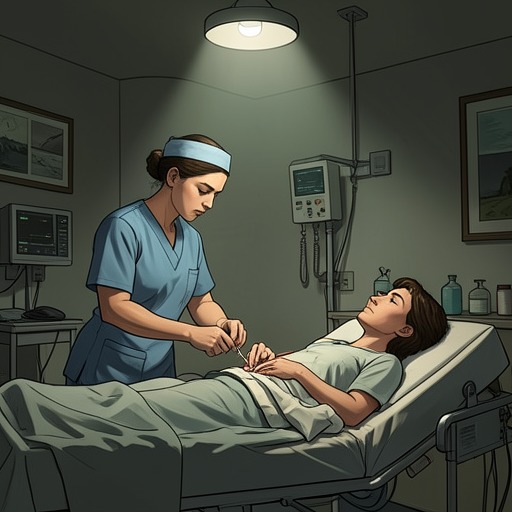
The hospital gave Cullen more than employment. It placed him near vulnerable patients, medication, and routines whose ordinary appearance could conceal interference. He preferred the hospital at night, when administrators, visitors, and other nonessential activity had receded. In a private room, a nurse could approach an intravenous line under the accepted pretext of routine care; in a unit built around one-on-one attention, a patient might be isolated even while surrounded by a large institution.
One account shows how easily a lethal injection could be made to resemble legitimate work. Cullen injected digoxin into the piggyback port of an older woman’s intravenous line, an access point nurses commonly used to flush a line with saline. Digoxin was clear, like saline, and the action itself looked ordinary. He understood that, if interrupted, he could present it as routine. No one entered the private room. The scene turns on a grim inversion: the same familiarity that made him competent to care for a patient also helped him make an attack look like care.
His use of the medication room offered another combination of access and concealment. After a pharmacy runner delivered medicines for the night shift, Cullen carried them to the supply room, entered his code, and closed the door. He found enclosed spaces peaceful and, alone in the darkened room, changed from a direct approach to an indirect one. The passage does not make solitude a cause of his crimes; it shows how the hospital’s ordinary spaces and medication workflows provided opportunities that could be exploited without immediately appearing extraordinary.
Cullen also used combinations of drugs rather than relying on a single substance. Amy Loughren later explained to investigators that he had drawn some drugs from the Pyxis system and obtained others outside its records, combining medicines with different biochemical effects. In combination, she said, smaller amounts could push a vulnerable patient toward death as one drug’s effect reinforced or counteracted another’s. The explanation helped make sense of why a medication record could be both revealing and incomplete: a drug’s presence in the cabinet did not prove it had been administered, while the absence of a drug from the record did not establish that Cullen could not have obtained it.
The evidence also records a series of distinct attacks and suspected attacks. At Somerset Medical Center, Cullen injected four ampoules of insulin into James Strickland’s intravenous port with a 10 cc syringe, discarded the syringe and ampoules in the sharps bin, signed out, and went home. He did not witness Strickland’s convulsions, but had the commute to imagine them. The book also names patients whose cases illustrated the range of drugs and outcomes: Melvin Simcoe was given sodium nitroprusside until his blood was dangerously thinned; Philip Gregor was poisoned and suffered a cardiac code but survived; Frances Agoada’s blood sugar rose dangerously after an insulin overdose; and Krishnakant Upadhyay’s heart was stopped with massive doses of digoxin. Cullen recalled other cases incompletely, and not every event described in his recollections has the same level of independent confirmation.
Warnings, Transfers, and the Problem of Proof
Earlier concerns at Saint Barnabas Medical Center later appeared strikingly close to methods Cullen would acknowledge. Incident reports described him checking a patient’s insulin levels repeatedly at inexplicable intervals and leaving an unlabeled intravenous bag in place of prescribed potassium chloride. He had pinched off the line so that the next nurse would start the drip. When a supervisor called him at home, he seemed apathetic and said that, if the bag was hanging there, it must contain the prescribed solution. Investigators could not establish what the bag actually held. The uncertainty mattered because Cullen later admitted to randomly spiking saline bags with insulin and sometimes ensuring that other nurses infused them when he was absent. In the earlier incident, the withheld medication, unlabeled replacement, and interrupted infusion made the episode more troubling than a simple dosage error, but did not resolve the bag’s contents.
At Saint Barnabas, staff had liked Cullen because he was helpful, even as he became the focus of an internal investigation involving insulin-contaminated intravenous bags and was eventually fired for nursing-practice issues. Amy Loughren later remembered Cullen telling her that his first killing at that hospital was a young woman’s death. He was never tried for that patient’s death. The contrast between his helpful reputation and the suspicions attached to his clinical conduct recurs across his career: being liked or useful could coexist with evidence that demanded a more searching response.
Cullen’s transfer from Saint Luke’s to Sacred Heart Hospital shows how quickly a move could take place. Three days after Saint Luke’s security escorted him to his car, on June 8, he arrived early for another night shift in another cardiac care unit. He could truthfully list his Saint Luke’s employment as continuing through June, and the hospital supplied neutral references. Some Saint Luke’s administrators were contacting colleagues elsewhere, but they had not contacted Sacred Heart. Cullen went directly into orientation and was due to start at once.
The evidence gathered later at Saint Luke’s similarly exposed the distance between institutional review and a conclusion that harm had occurred. After a district attorney referred the matter to law enforcement, the hospital commissioned an outside physician to review patient charts, but the review still did not lead it to conclude that Cullen had harmed patients. Cullen later confessed to killing five of the decedents at issue in the cases discussed, and seven Saint Luke’s patients have been specifically identified as having been killed by him. The distinction between what an internal review concluded and what later evidence established is central to the book’s account of how he remained employable.
At Somerset, the absence of records and physical evidence made the investigation especially difficult. The hospital’s five-month internal inquiry produced four pieces of paper but no answers that investigators could use to reconstruct the poisonings. Mary Lund could not provide Pyxis drug records, and Paul Nittoly could offer neither interviews nor background material. Investigators knew patients had been poisoned, but lacked a reliable account of how the drugs had reached them. Meanwhile, officials argued over whether the matter belonged to the hospital, health authorities, or police. Poison Control director Steven Marcus believed the pattern indicated deliberate killing and warned that further delay could expose more patients to harm; Bruce Ruck repeatedly insisted that it was a police matter. The institutional boundary did not resolve the case. It slowed the passage from suspicion to action.
Investigation and the Records That Fell Short
Hospital security and police eventually narrowed attention to Cullen through the timing of patient emergencies. At Saint Barnabas, Thomas Arnold and Joe Barry compared nursing schedules with the dates and times of patient codes. Only three nurses had been working every code under review, and Cullen drew particular attention. At Somerset, however, the records that might have connected a particular nurse to a particular drug were missing or inadequate. Investigators could suspect the person and understand the pattern without possessing proof that would persuade a jury.
One Pyxis record illustrates the discrepancy. Cullen’s record for the night of October 20 listed a long series of medicines, including furosemide, insulin, propofol, heparin, norepinephrine, and dobutamine, but no digoxin. The charts recorded that Ed Zizik’s heart stopped at about 2:30 a.m. on October 21 from a digoxin overdose; digoxin appeared neither on Zizik’s chart nor in Cullen’s Pyxis activity for the night. The mismatch was significant, but it did not by itself show how Cullen had obtained the drug or prove who administered it. Investigators could see a gap between the recorded medication and the fatal substance without yet bridging that gap in court.
The toxicology results in the death of Reverend Florian Gall provided a firmer finding about cause and manner of death. A laboratory report identified digoxin in the vitreous fluid, spleen, heart, and kidney, including 104 micrograms per kilogram in the kidney. After the report, the medical examiner could classify the death as digoxin toxicity and homicide. That established both a victim and a weapon, but the investigators still lacked a sure means of convicting the person responsible. Pyxis reports and Cerner printouts linked Cullen to opportunities to obtain drugs; they did not, on their own, prove murder.
The limits of the evidence shaped the investigators’ decisions. Tim Braun and Danny Baldwin believed Cullen was a killer, but they did not think the facts then assembled could establish a Somerset crime before a jury. Arresting him prematurely, they feared, would alert him to the surveillance while leaving him free to return to the street. The case therefore depended not only on recognizing a pattern but on finding a way to connect that pattern to acts and victims with evidence strong enough to withstand legal scrutiny.
Amy Loughren, Confession, and the Extent of the Crimes
Loughren’s knowledge came from having worked beside Cullen. She remembered him wheeling a portable Cerner computer down the corridor after report, wearing a cardigan and appearing to seek quiet. She had not understood that his position near the corridor doors also placed him near the arrival of drugs. Once she considered the routes by which medicines entered the unit and compared them with Cullen’s activity, she brought her findings to Braun and Baldwin. The insight enlarged the investigation: the relevant question was not limited to what Cullen had withdrawn from Pyxis, but also what he might have obtained beyond the system.
Her cooperation carried a personal cost. Coworkers knew her as Cullen’s friend and remembered her objections when asked to sign for insulin quantities she could not accurately estimate. They understood that a death had become associated with both insulin and Cullen, and some began avoiding her as though suspicion could spread by association. Her friends worried for her; she was frightened for herself. The friendship that had once made Cullen seem familiar now placed Loughren in a position where she had to help investigate him while colleagues questioned what she knew.
The detectives ultimately arranged a traffic stop that separated Cullen’s arrest from the later interrogation. Danny Baldwin had radioed officers positioned nearby; Braun and Baldwin did not want to make the arrest themselves because the person who advised a suspect of his rights could not then be part of the interrogation team. A marked police car made the stop look routine, preserving the possibility that Cullen might later speak with investigators in civilian clothes. Afterward, Cullen sat in the interrogation room with his feet tucked up and Loughren’s cardigan over his shoulders. The detectives began with Gall, but Cullen continued beyond that case, turning his account into a long narrative about himself and the hospitals where he had worked.
Cullen initially confessed to killing perhaps forty people, but the confession was incomplete. He missed names, skipped whole years and hospitals, and would not guess when he was uncertain. At Lehigh Valley Hospital, he recalled four or five victims, while two had then been positively identified; at Hunterdon Medical Center, he initially denied overdosing patients, but five victims were ultimately discovered there. Experts familiar with the case believed the total was likely closer to four hundred. The book therefore distinguishes the scale suggested by the wider investigation from the number Cullen could personally recount and the crimes established in court.
In April 2004, Cullen pleaded guilty in New Jersey to thirteen murders and two attempted murders, offenses that made him eligible for the death penalty. He had told Loughren and investigators that he wanted to be executed, but did not tell his court-appointed lawyer, Johnnie Mask. Cullen and Mask reached an agreement with prosecutors: the death penalty would be removed in exchange for his cooperation. Danny Baldwin and the Somerset County Prosecutor’s Office team then spent three further years investigating. The legal resolution was substantial, but it did not make the full number of victims knowable. The media called Cullen the Angel of Death; the book leaves the exact total unresolved, placing his conviction alongside a far larger and less certain trail of deaths.